Sarooj on Blogger!

Showing posts with label Information technology. Show all posts

Sunday, 3 February 2013

Meaningful Use Stage II - What You Should Know?

The final rules of meaningful stage two are finally debuted. Providers and practices have another challenge of complying to these rules in order to earn meaningful use bonus. According to the final rules, 2014 is the earliest effective date for stage 2. All the menu measures of stage 1 except ‘Syndromic Surveillance’ are made core measures in stage 2. In addition to prescriptions, now the computerized physician order entry (CPOE) also includes radiology and lab orders.  

As said by Farzad Mostashari, MD, national coordinator for health IT, stage 2 will take time, “to make the most meaningful use of meaningful use.” The stage 2 also reinforces importance of a patient portal so that they can access to their medical records easily.


Now physicians have to make sure that at least 5% of their patients view, send and download their clinical information. Similarly, over 5% of the patients should communicate clinical information with doctors through secure email. After each visit, clinical information must be available to patients within 1 day. The five new menu measures added to stage 2 includes family history, imaging results, progress notes, reporting to cancer registries and reporting to specialized registries. 

Now the electronic health record (EHR) vendors have another benchmark to enhance the EHR. The best EHR will be one that will help providers in complying with meaningful use stage 2 rules.
Meaningful Use Stage 2

Friday, 1 February 2013

A Global Network: Google Earth

Google Earth is a virtually global network. It draws a network of images, satellite and 3D information. Every individual is enjoying the assistance of it. The Google Earth has added advantages for its targeted Customers. Personal and Commercial usage has helped countless people to engender fruitful thoughts from it.

The Google Earth is easily available as a net browser, a relieve for frequent mobiles viewers as well. Not only this, but you can get latest information on a Single –Click.

To download latest data and records just go to Android Market via your android phone and search for all information on Google Earth. And recently, it introduced many new versions and tactics to spawn innovative fresh techniques in three-dimensional data via Keyhole Markup Language (KML), available in 47 languages, an ease for its new users.

We can easily explore new places and industrial areas, for re-location, starting new projects, and construction based assignments. This new network is also used, scrutinized and studied for future research purposes as well. 

With the help of Google Earth's rich and geographical content, you’ll surely be pleased to experience a more realistic view of the world by sitting at your home. You can visit your favourite place, search for new businesses and can easily pilot through new directions. Widening up by saying that "Hub of Knowledge is another name for Google Earth".

Tuesday, 15 January 2013

Reluctance of US Doctors in Adopting EHR Technology

Abstract:
The purpose of this research is to identify the major barriers which are confronted by Physicians and doctors in the adoption of Electronic Health Records (EHRs). This study will lead to various relative dimensions of Health Information Technology (HIT) with the involvement of Meaningful Use, Generic Role of the Government, and Technology evaluation. These selected variables will help us to develop a composite view on this study. The proposed theoretical framework evaluates the degree of reluctance in physicians along with imminent challenges, possibilities and plans that will streamline future incentives too.
    
Keywords:
Doctors, Providers, Electronic Health Records (EHRs), Focus groups, Role of the 
Government, Meaningful Use, Technology Evaluation, USA.

Acknowledgements:
The authors of this paper would like to thank MTBC for continuous support throughout this project. www.mtbc.com 


GJMBR Classification : JEL Code : I

To read the complete article please click: http://is.gd/aCemwj

US Doctors are reluctant to adopt EHR Technology

Friday, 21 December 2012

Proactive Patients Seeking Healthcare Information Prefer Surfing The Web Over Turning Pages In A Reference Book

A new study, from the University of California, Davis shows that patients prefer using the internet to obtain healthcare information over asking friends or using reference books. This study, based on a survey of over 500 people, magnified the desire of patients to be proactive in managing their health. “The Internet has become a mainstream source of information about health and other issues,” said Xinyi Hu, who co-authored the study as part of her master's thesis in communication. “Many people go online to get information when they anticipate a challenge in their life. It makes sense that they would do the same when dealing with a health issue.”
Furthermore, the study pointed out that proactive patients do not mistrust their doctors; they simply want to gain personal control over their health. "The study revealed that patients are not turning to the Internet out of any doubt; more likely, Internet users are curious information seekers who are just trying to learn as much as they can before their appointment”, said co-author Richard L. Kravitz, a UC Davis Health System professor of internal medicine and study co-author.
The basic value of PHR platform is to embrace the patient-specific clinical information quickly, accurately, reasonably, and safely. We anticipate that many other medical institutions will probably face challenges, but the proactive approach with open and constant communication between the patients and doctors provides safe information which overcomes many inevitable issues that arise timely. Proactive approach for an individual clinical data is a very new conduct. It will take time to become common with substantial progress.
Seeing as this, PHR is an easy gateway in providing personal online portal from which patients can record, track and even save their important health related information at one secure online place. They can easily manage their personal health records like demographic information, appointment history, lab-test results, payment reports, outstanding balances and claim history, available 24/7 from any Internet-ready computer. Level of trust between a doctor and a patient gets more compact since online information-seeking is higher among the patients who get all the information from internet, recent survey (2012).
Almost 70% of the study subjects reported they were planning to ask their doctor questions about the information they found on the internet, and about 40 percent said they had printed out information to take with them to discuss with their doctors. More than 50 percent of subjects said they intended to make at least one request of their doctor on the basis of Internet information, recent survey (2012).

In February 2011, there were more than 12,000 groups listed in the support category of Yahoo! Groups Health and Wellness directory. Only 9% of Americans and 37% of patients with continual disease have participated in online support groups, so the doctors need to be attentive and alert to provide the same degree of reassurance, their patients expects from them, (2012). Moreover, majority patients feel much comfortable to get any sort of online information from their doctors. This has also developed trust and confidence among the patients, who prefer online health solutions. 
Personal Health Records (PHR) 

Aetna second quarter faced 15% decline in its profits

Aetna, Inc. is an American health insurance company. It provides its customers with traditional and consumer-directed healthcare benefits with products and related services such as medical, pharmaceutical, dental, behavioral health, group life, and disability plans. Aetna is in collaboration with an ACO to improve care management and fix payment models, said Internet search.

Recently Aetna announced second-quarter 2012 results with the earnings of $452.0 million, or $1.31 per share compared to the $1.35 per share reported in the second quarter of 2011. Favorable before-tax prior-period reserve development in the second quarters of 2012 and 2011 was approximately $38 million and $188 million, respectively. Excluding the after-tax impact, operating earnings were $427.9 million and $401.5 million in the second quarters of 2012 and 2011, respectively, and improved in 2012 mainly due to higher underwriting margins and increased membership in our Medicare business.

  1. Total medical benefit ratio was 82.4 % in the second quarter 2012
  2. Medical membership totaled 18.0 million members at June 30, 2012
  3. Aetna now projects full-year 2012 operating earnings per share to be $5.00 to $5.10
Major reason for the 15% downfall in the second-quarter earnings was of a smaller benefit from surplus money set aside to cover earlier patient claims, said Online Business news. Aetna's overall performance is based on sustained execution on the fundamentals where memberships and revenues are rising rapidly with projecting latest medical cost trends on top.


Thursday, 20 December 2012

Internet simplifies a Doctor-Patient Relationship

Information technology era has come up with many dynamic changes. It effectively settles the doctor-patient relationship too. Users generally prefer Internet to seek online health information instead of asking friends and going through reference books, offline sources or even health news reports. Internet is one of the primary concerns that provide all the information about health and related issues. Majority patients go with online searches to handle their medical problems not because they mistrust their doctors, as now they believe that personal control over their illness can be figured out very easily.

Patients will never suffer from any problem, while setting their medical appointments with the doctors. Personal Health records (PHR) is one of the unique contributions that provides patients an online access to get their past and current health information directly from their doctor’s website. With PHR, patients get information about their personal assessments, medications, general allergies, immunizations and procedures too.

PHR is completely free and reliable. Patients can get their personal online portal from which they can record, track and even save their important health related information at one secure online place. With the improved workflow and efficiency of a practice, free technical support is also provided where needed. Patients can easily manage their personal health records like demographic information, appointment history, health records, lab tested results, payment reports, outstanding balances and claim history, available 24/7 from any Internet-ready computer. Level of trust between a doctor and a patient gets more compact since online information-seeking is higher among the patients who get all the information from Internet.

Doctors play a dynamic role in supporting online health challenges. They need to be attentive and alert to provide the same degree of reassurance, their patients expects from them. Direct communication through the patient-doctor communication module and viewing direct comments from the personal providers strengthen a Doctor-patient relationship. Moreover, majority patients feel much comfortable to get any sort of online information from their doctors. This has also developed trust and confidence among the patients, who prefer online health solutions.

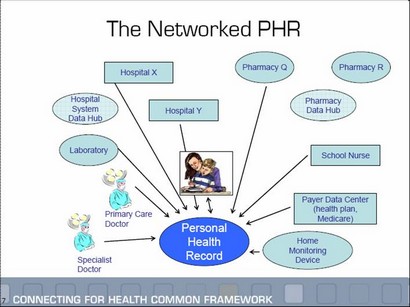
PHR allows online scheduling, from which patients can simply schedule their own appointments directly through the practice’s website. An ideal PHR holds an incredible ability, since it can easily get and assess the information from a patient's lab results or monitoring devices; store a patient's remarks about the physical and social environment and link with a doctor’s electronic health record (EHR). PHRs can also make health care more reasonable by urging avoidance and wellness, and by reforming better care delivery.
Personal Health Record (PHR)